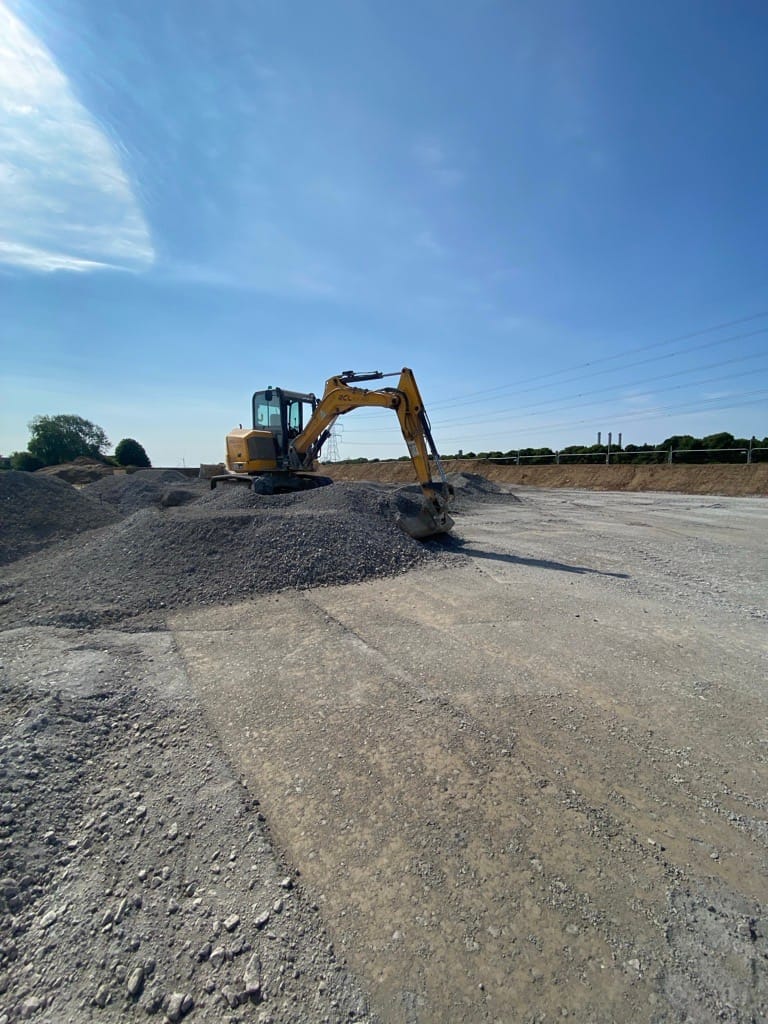
Across the UK, the construction industry is under growing pressure to deliver projects more sustainably, cutting carbon emissions while reducing reliance on primary materials. One material helping to achieve this is Incinerator Bottom Ash Aggregate (IBAA) – a manufactured aggregate derived from the by-products of Energy-from-Waste facilities.
Used successfully for over two decades, IBAA is no longer experimental; it is a proven, reliable, and widely accepted construction material. This article explores what IBAA is, how it is produced, its safety credentials, where it is used, and the significant environmental and cost benefits it delivers.
Table of Contents
What is Incinerator Bottom Ash (IBA) and How is IBAA Produced?
When household or commercial waste is processed at an Energy-from-Waste (EfW) facility, combustion leaves behind a mineral residue known as Incinerator Bottom Ash (IBA). This ash typically contains fragments of glass, ceramics, metals, brick, clinker, and stone within a fine, dusty matrix.
Instead of sending this material to landfill, IBA can be transformed into a valuable construction aggregate. Specialist recycling facilities operated by companies such as Day Aggregates at Avonmouth, Brentford, Greenwich and Wellingborough carry out this process.
The key stages of production include:
- Aging or Weathering – Fresh IBA is stockpiled outdoors for several weeks. This allows chemical stabilisation, reducing lime reactivity and improving leachate behaviour
- Metal Recovery – Powerful magnets and eddy current separators remove ferrous and non-ferrous metals. These metals are recycled separately, boosting circular economy outcomes
- Crushing and Screening – The mineral fraction is processed into defined particle sizes, producing a consistent sand-to-gravel blend
- Blending and Refinement – Where required, IBAA may be mixed with other materials (such as natural stone) to meet technical specifications
The result is IBAA, a stable, granular material that looks and performs like quarried primary aggregate. It has been applied successfully in roads, platforms, and hard standings for more than 20 years.
Is IBAA Hazardous or Safe to Use?
IBAA is classified as non-hazardous when processed correctly.
Strict industry testing, including protocols set by the Environmental Services Association (ESA), ensures the material does not exhibit hazardous properties. Only non-hazardous IBA (waste code 19 01 12) is accepted for processing into aggregate.
By the time it becomes IBAA:
- Metals and contaminants have been removed
- The material has stabilised through aging
- Its pH, leaching behaviour, and heavy metal content are tested to meet regulatory safety thresholds
While regulators still consider IBAA a “waste” until End-of-Waste criteria are formally adopted, in practice it is a safe, stable material suitable for approved construction uses. As with all secondary aggregates, it must be applied in line with regulatory guidance – for example, avoiding sensitive groundwater locations – but within these parameters it is considered safe.
Environmental Benefits of IBAA
The environmental case for IBAA is compelling. Its benefits include:

Landfill Diversion
Every tonne of IBA processed into aggregate prevents roughly 530 kg of municipal waste (around 530 black bin bags) from going to landfill

Carbon Reduction
With many EfW plants located near cities, IBAA facilities are often closer to construction sites than quarries. Reduced transport distances cut carbon emissions, while the EfW process itself offsets fossil fuel energy by generating electricity

Resource Preservation
Each tonne of IBAA used replaces approximately 1.1–1.3 tonnes of quarried primary stone, protecting landscapes and ecosystems

Circular Economy
IBAA is the perfect example of converting a waste by-product into a useful material, aligning with sustainability policies and recycled content targets
Supporting Carbon and Sustainability Targets
Incorporating IBAA into projects supports both corporate carbon goals and procurement frameworks such as BREEAM.
- As a recycled material, IBAA reduces embodied carbon by avoiding quarrying
- Because it is lighter by volume than primary stone, fewer tonnes are required, reducing lorry movements
- Many public and private clients have internal mandates to use a percentage of recycled aggregates – IBAA helps meet those requirements
For contractors and clients working toward Net Zero, IBAA represents a practical, measurable contribution to carbon savings.
Performance and Durability Compared with Primary Aggregates
IBAA is produced to the same grading and quality controls as primary materials, ensuring equivalent performance.
- Strength and Stability – When used as Type 1 or 6F4/6F5, IBAA compacts to form a strong, load-bearing layer
- Durability – The mineral fragments (glass, ceramics, stone) are inherently robust
- Frost Resistance – Properly compacted IBAA is non-frost susceptible
- Pozzolanic Properties – A unique feature of IBAA is its mild self-cementing ability, as oxides within the ash can harden over time, increasing strength in service
Two decades of real-world use demonstrate that IBAA performs reliably, often with enhanced durability compared with primary aggregates.
Specifications and Standards
IBAA is recognised under the Specification for Highway Works (SHW) and European standards.
- BS EN 13242 – Aggregates for unbound and hydraulically bound materials
- BS EN 13285 – Mixtures such as Type 1 sub-base
- SHW Clause 803 – Defines Type 1 unbound sub-base
- SHW Clause 613 – Covers capping materials such as 6F4 and 6F5
Major clients including National Highways accept IBAA where it meets these specifications. Suppliers operate rigorous factory production control systems, often under ISO 9001, to ensure ongoing compliance. Documentation can be found in Ecoblend Resources.
Efficiency: Do You Need More Material?
One advantage of IBAA is its lower bulk density – typically around 2.0 t/m³ compared with 2.3–2.4 t/m³ for limestone or granite.
This means you need about 10–15% less tonnage of IBAA to achieve the same volume. In practice, a project requiring 100 m³ of sub-base might need ~190 tonnes of IBAA instead of ~220 tonnes of primary aggregate.
This volumetric efficiency reduces the number of lorry deliveries and handling costs. To see the savings you could make visit the Ecoblend Material Calculator.
Material Cost Effectiveness
IBAA is generally cost effective compared to primary quarried stone, for several reasons:
- Lower raw material costs (IBA is a recovered by-product)
- Exemption from the Aggregates Levy, which adds £2/t to primary materials
- Reduced tonnage required for equivalent volume
- Local sourcing often reduces haulage costs
The combination of these factors makes IBAA a consistently materially efficient choice for contractors and clients.

View our Walstead Park Case Study to see how one of our clients made material savings of almost 50% using our IBAA-based product.
Handling and Installation Considerations
Using IBAA is very similar to working with crushed concrete or recycled aggregates, with a few practical points:
- Moisture Conditioning – Delivered slightly damp for compaction. If dry, a light water spray aids binding (to learn more, read the ‘Moisture Matters‘ article on the Day Aggregates website)
- Dust Control – Suppress dust where possible when required
- Compaction – Place in 150–250mm layers and compact with standard vibratory rollers
- Covering – Must not be left exposed; always finish with asphalt, concrete, or paving
Suppliers such as Day Aggregates, GRS Roadstone, and GRS Stone Supplies provide guidance and testing data to support correct site practice.
Regulatory Requirements
In England, IBAA use is governed by the Environment Agency’s Regulatory Position Statement 247 (RPS 247).
This allows IBAA to be used in specific unbound applications (sub-base, capping, structural fill, etc.) without requiring an individual permit, provided conditions are met.
These include:
- Only using fully processed, non-hazardous IBAA
- Avoiding sensitive locations such as floodplains or groundwater protection zones
- Ensuring material complies with BS EN 13242
In practice, for standard applications, no special permit is required if RPS 247 conditions are followed.
Market Acceptance and Track Record
IBAA has moved firmly into the construction mainstream. Around 3 million tonnes are used in UK projects annually.
- Public Sector – Local authorities and National Highways specify IBAA in road schemes
- Major Projects – IBAA has been used in the London Olympic Park, highway bypasses, distribution centres, and housing developments
- Confidence – Over 20 years of successful use has dispelled early concerns
IBAA is now recognised as a reliable, proven material by both clients and regulators.

The Role of MIBAAA
The Manufacturers of IBA Aggregates Association (MIBAAA) represents the industry and sets quality benchmarks.
MIBAAA works with regulators to develop codes of practice, promote high standards, and advance End-of-Waste criteria. Contractors sourcing from MIBAAA members can be confident that the aggregate meets consistent safety and performance standards.
To learn more about MIBAAA and the role they play in the construction industry, visit their website.
Conclusion
IBAA demonstrates how the construction industry can close the loop on waste, converting a by-product of modern living into a valuable resource.
- It performs to the same specifications as quarried aggregate
- It delivers proven environmental and carbon savings
- It offers cost and logistical advantages
- It is accepted by clients, regulators, and contractors nationwide
For projects seeking to balance performance, value, and sustainability, IBAA represents one of the most practical, large-scale recycled aggregates available today. Through suppliers like Day Aggregates, GRS Roadstone, and GRS Stone Supplies, Ecoblend (produced under licence from Day Group Ltd), is helping shape a more resource-efficient, lower-carbon construction sector.
View our Case Studies
Take a look at our Case Studies and find out how our IBAA-based product, Ecoblend, can help your next project achieve its sustainability goals.